
How to Sleep Better on Planes and in Hotels
Travelling disrupts sleep more than most people expect. Between cabin pressure, recycled air, unfamiliar beds, and unpredictable noise, even seasoned travellers often arrive at their destination exhausted. The good news: a few deliberate habits and the right tools can make a significant difference.
Why Travel Disrupts Sleep
Your body relies on environmental cues, light, temperature, sound, and routine to regulate your sleep-wake cycle. Travel strips most of these away. Time zone shifts confuse your circadian rhythm, hotel rooms are often too bright or too warm, and the constant hum of aircraft engines keeps your nervous system on low-level alert.
Understanding this helps you address the root causes rather than just hoping for the best.
On the Plane
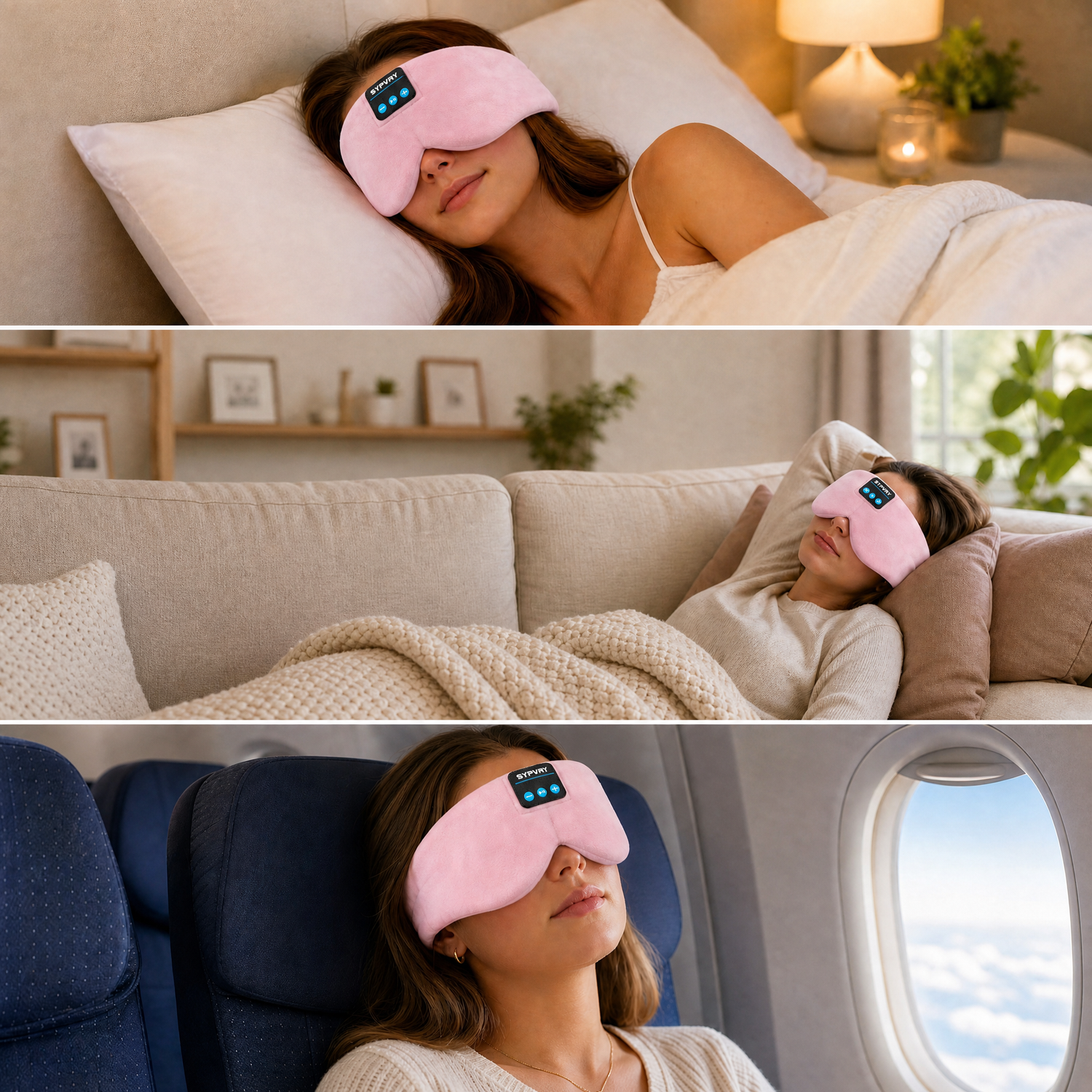
Block out light completely. Aircraft cabins are poorly designed for sleep, overhead lights, screen glare from other passengers, and the unpredictable brightness of sunrise at 35,000 feet all work against you. A well-fitted sleep mask that blocks 100% of light is one of the most effective tools you can use. If you want to listen to a sleep playlist or white noise without disturbing your neighbour, a Bluetooth sleep mask combines both functions in one.
Manage noise proactively. Engine noise sits at a frequency that's particularly disruptive to light sleep. Quality earplugs reduce this significantly. Pair them with a sleep mask for a near-complete sensory blackout.
Adjust your position. Sleeping upright is physiologically awkward. A neck pillow that supports the cervical spine reduces the tension that builds up when your head drops forward. Recline as far as courtesy allows, and consider a small lumbar support if you're prone to lower back stiffness.
Avoid alcohol. It's tempting to use a glass of wine to take the edge off, but alcohol fragments sleep architecture and reduces REM sleep meaning you wake up feeling worse than if you'd slept less but more deeply.
Time your sleep intentionally. If you're crossing time zones, try to sleep in alignment with your destination's night-time rather than your departure city's. This accelerates adjustment and reduces jet lag duration.
In the Hotel
Control the light environment. Hotel blackout curtains are inconsistent many have gaps that let in streetlight or corridor light. Bring your own sleep mask as a reliable backup. It weighs almost nothing and guarantees darkness regardless of the room.
Lower the thermostat. Core body temperature needs to drop slightly to initiate sleep. Most hotel rooms default to warmer settings. Set the thermostat to 16–19°C (60–67°F) if possible, or use a fan for airflow.
Recreate your routine. Your brain associates certain behaviours with sleep onset. If you normally read for 20 minutes before bed, do the same in the hotel. Consistency signals to your nervous system that it's time to wind down.
Minimise screen exposure. The blue light from phones and laptops suppresses melatonin production. If you need to use your phone, switch to night mode and keep it brief. Better still, use the time before bed to decompress without a screen.
Use white noise. Many hotel rooms are noisier than expected corridors, air conditioning units, street traffic. A white noise app on your phone (played quietly through a speaker or earphones) can mask these interruptions effectively.
The Gear Worth Packing
You don't need much, but what you bring matters. A compact, well-designed sleep kit, sleep mask, earplugs, and a neck pillow takes up minimal space and pays dividends in how you feel on arrival. If you travel frequently, it's worth investing in quality rather than relying on whatever the airline provides.
Sleep is not a luxury when you travel. It's the difference between arriving ready and arriving depleted.

Leave a comment
This site is protected by hCaptcha and the hCaptcha Privacy Policy and Terms of Service apply.