
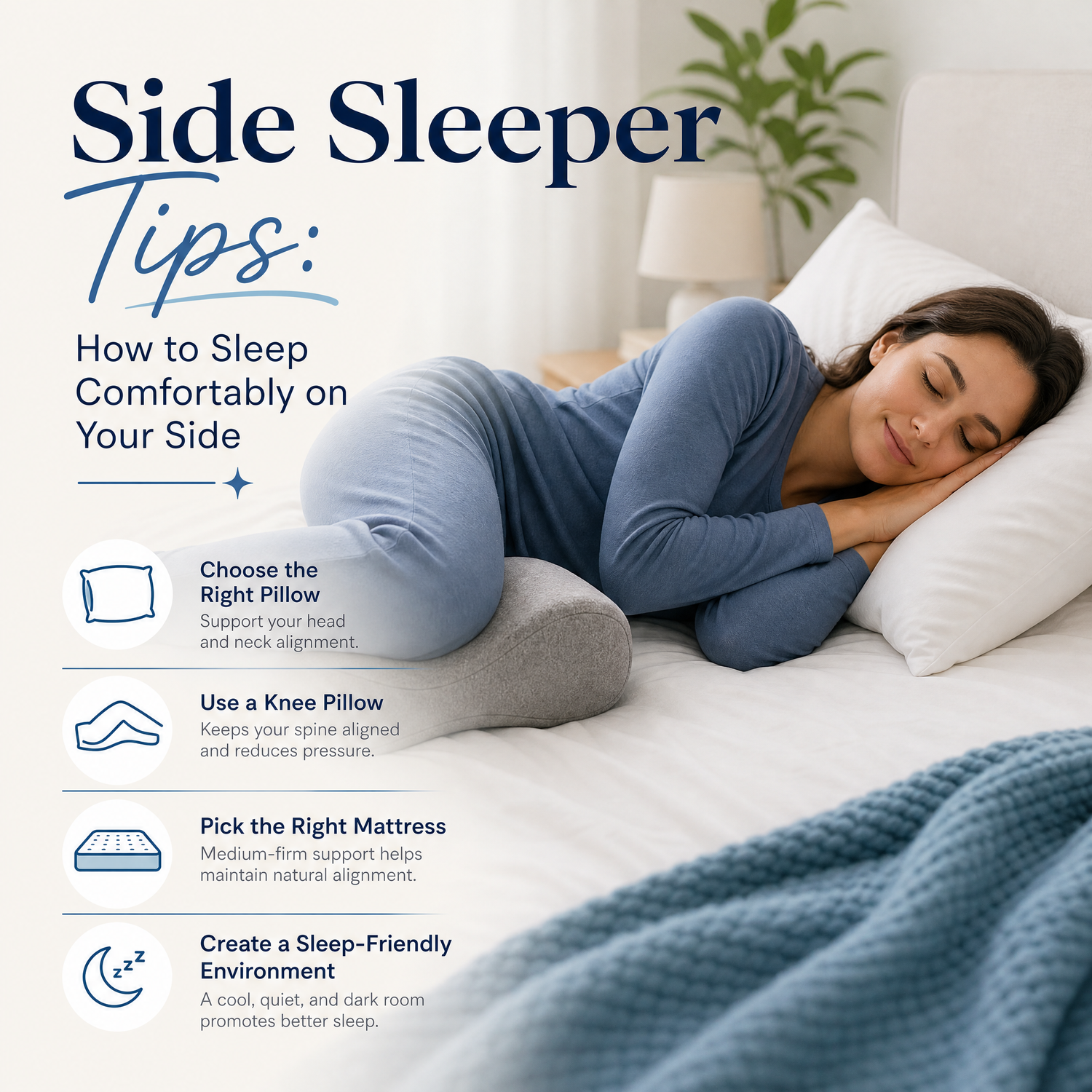
Side sleeping is the most popular sleep position roughly 60% of adults default to it. It has genuine benefits: it reduces acid reflux, supports spinal alignment when done correctly, and is associated with lower rates of snoring. But it also comes with specific challenges that, left unaddressed, lead to shoulder pain, neck tension, and disrupted sleep.
Here's how to get it right.
The Benefits of Side Sleeping
Before addressing the challenges, it's worth understanding why side sleeping is worth optimising rather than abandoning.
Sleeping on your side particularly the left side reduces pressure on the oesophagus, which can alleviate acid reflux symptoms. It also encourages nasal breathing, which is associated with better oxygen uptake and reduced snoring. For pregnant women, left-side sleeping improves circulation to the foetus. And for those prone to sleep apnoea, side sleeping reduces airway obstruction compared to back sleeping.
The Challenges of Side Sleeping
The primary issues are mechanical. When you sleep on your side without proper support, your spine curves laterally, your top shoulder rotates forward, and your neck tilts toward the mattress. Over a full night, this creates cumulative tension in the cervical spine, shoulders, and hips.
The result: you wake up stiff, sore, or with a dull ache that takes an hour to resolve. This isn't inevitable it's a setup problem.
Pillow Height: The Most Important Variable
For side sleepers, pillow loft (height) is critical. Your pillow needs to fill the gap between your head and the mattress keeping your cervical spine in a neutral, horizontal position. Too low, and your head drops toward the mattress. Too high, and your neck tilts upward.
The right loft depends on your shoulder width. Broader shoulders require more loft; narrower shoulders require less. As a general guide, most side sleepers need a medium-to-firm pillow with a loft of 10–15cm.
Memory foam and latex pillows tend to hold their shape better than down or polyester fill, which compress under the weight of your head and lose their supportive properties over time.
Shoulder Positioning
One of the most common side-sleeping mistakes is lying directly on the shoulder joint. This compresses the rotator cuff and restricts blood flow, leading to numbness or aching that wakes you during the night.
Instead, position your shoulder slightly forward so you're resting on the meaty part of the upper arm rather than the joint itself. This small adjustment distributes weight more evenly and reduces pressure on the shoulder.
Hip and Knee Alignment
Without support between the knees, the top leg drops forward and rotates the pelvis, creating tension in the lower back and hips. Placing a pillow between your knees keeps the hips stacked and the spine aligned. This is particularly important if you experience lower back pain.
Arm Positioning
Sleeping with your arm extended above your head or tucked under your pillow restricts circulation and can cause the pins-and-needles sensation that wakes you. Keep your arms in front of you, slightly bent, at roughly chest height.
Mattress Firmness
Side sleepers generally benefit from a medium-soft to medium mattress. A mattress that's too firm doesn't allow the shoulder and hip to sink in enough, creating pressure points. Too soft, and the spine sags. The goal is a surface that contours to your body while maintaining spinal alignment.
Light and Noise
Side sleepers face a specific challenge with sleep masks: many traditional masks press against the eyes when you're lying on your side, creating pressure that's uncomfortable enough to disrupt sleep. A 3D contoured sleep mask designed with a raised structure that doesn't contact the eyes solves this. It maintains complete darkness without the pressure, regardless of which side you're on.
Similarly, earplugs can shift position during the night for side sleepers. Flat, disc-style earplugs tend to stay in place better than cylindrical foam ones.
A Note on Switching Sides
If you always sleep on the same side, you may develop asymmetric muscle tension over time. Alternating sides even if it takes a few nights to feel natural distributes the load more evenly and can reduce chronic one-sided stiffness.
The Setup That Works
The ideal side-sleeping configuration: a supportive pillow at the right height, a pillow between the knees, a medium mattress, and a contoured sleep mask if you need darkness. It takes a few nights to adjust, but the difference in how you feel in the morning is noticeable.
Side sleeping done well is one of the most restorative positions available. The setup is worth getting right.



Leave a comment
This site is protected by hCaptcha and the hCaptcha Privacy Policy and Terms of Service apply.